Opposition to the avalanche of lorries crossing the Brenner Pass is growing. Tyrol is responding to the increasing volume of lorry transit with driving bans and block dispatches. Rail could ease the burden on the roads, the environment and local residents. Kombiverkehr alone handles 9,000 trains across the Brenner Pass every year and maintains the necessary capacity. However, rail transport also faces a number of challenges when it comes to cross-Alpine traffic. This is the situation facing freight railways, operators and their customers.
The message is unmistakable: ‘Freight by rail instead of an avalanche of traffic’, reads a purple banner in large white letters. On 30 May, thousands of residents took to the streets and protested in Matrei am Brenner against the traffic and transit burden on the region. Another protest followed on 1 August at the Fern Pass. As a result, two major routes from Germany to Tyrol were blocked for hours.
Local residents’ frustration with the increasing traffic, noise and pollution is growing. They feel let down by politicians and are vociferously demanding a solution – including effective noise protection, a higher lorry toll and a targeted shift to rail. The fact is: the roads and bridges are groaning under the weight of increasing heavy goods traffic. For safety reasons, the ageing Lueg Bridge has, for the most part, been open to traffic on a single lane only since January 2025. In 2025, almost eleven million cars and around 2.5 million lorries squeezed their way through this Tyrolean bottleneck.
Caught between climate protection and economic interests
The Tyrolean provincial government is attempting to reconcile the interests of the environment, the population and the economy through a wide range of measures. Some of these are particularly controversial within the transport and logistics sector. These include night-time driving bans and sector-specific driving bans for certain types of goods, as well as block clearance at the border crossing. The Tyrolean provincial government defends this measure. It refers to ‘traffic regulation measures’ designed to slow down lorry traffic in order to keep it flowing smoothly. It has set 30 days of traffic regulation for 2026.
For many logistics operators, Tyrol’s interventions in traffic management are a thorn in their side. Italy has taken legal action against the lorry driving bans in Tyrol and now feels vindicated in its position. Although a ruling from the European Court of Justice (ECJ) is still pending, a decision may already be taking shape: ECJ Advocate General Manuel Campos Sánchez-Bordona states in his Opinion that he considers the driving bans to be unlawful. He does not take issue with the controversial batch clearance system. The Tyrolean provincial government would be prepared to reconsider this measure provided it were replaced by another instrument: a slot system for pre-bookable lorry movements between Munich and Verona.
Brenner Base Tunnel set to ease congestion: opening planned for 2032
Whilst the roads are creaking under the strain, the bridges are reaching their limits and public discontent is mounting, rail could provide the hoped-for relief for transit traffic. Despite all the restrictions on road transport across the Brenner Pass, rail currently accounts for only 25 per cent of the modal split. Expectations are therefore high for the construction of the Brenner Base Tunnel (BBT) to achieve a noticeable shift of traffic onto rail. The world’s longest underground rail link is due to enter service in 2032, connecting Innsbruck with Franzensfeste in South Tyrol. Since August, the western tunnel, 55 kilometres long, has been fully excavated – a milestone for all those involved.
It is now crucial that the feeder lines are also expanded swiftly; otherwise, the system’s capacity will remain limited. Germany, in particular, is lagging behind in this regard. The country had long been trailing behind in the planning for a route. In July, the network operator DB InfraGO announced that the preliminary planning had been completed and a preferred route had been identified.
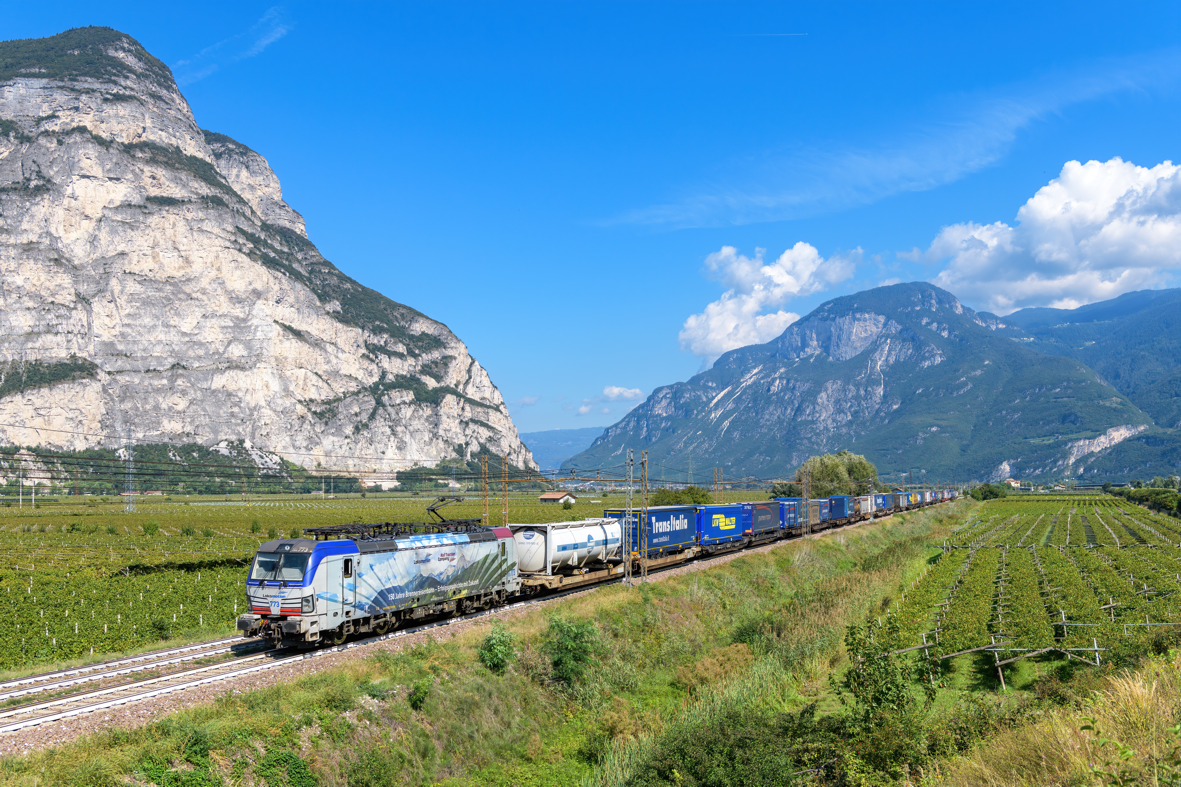
Regardless of the new lines being built, nobody needs to wait for this major project to be completed: there have been efficient rail services via the Brenner Pass for many years. At the German intermodal specialist Kombiverkehr alone, around 200 active customers use the services on this main route. Kombiverkehr handles around 9,000 trains a year, which corresponds to around 300,000 loading units. “For Kombiverkehr, the Brenner is the most important Alpine route for traffic to Italy,” explains Managing Director Dirk Steffes. The Frankfurt-based company offers daily departures, and from some German terminals even several times a day. Direct trains to northern Italy and back operate from Munich, Nuremberg, Cologne, Ludwigshafen, Hamburg, Hanover, Rostock and Lübeck. A new service from Regensburg to Verona was launched on 8 September. Other regions are connected via gateway services – such as the Leipzig chemical industry region, the Ruhr area and the German Baltic Sea ports, providing links as far as Northern Europe.
Combined transport as a solution to the driver shortage
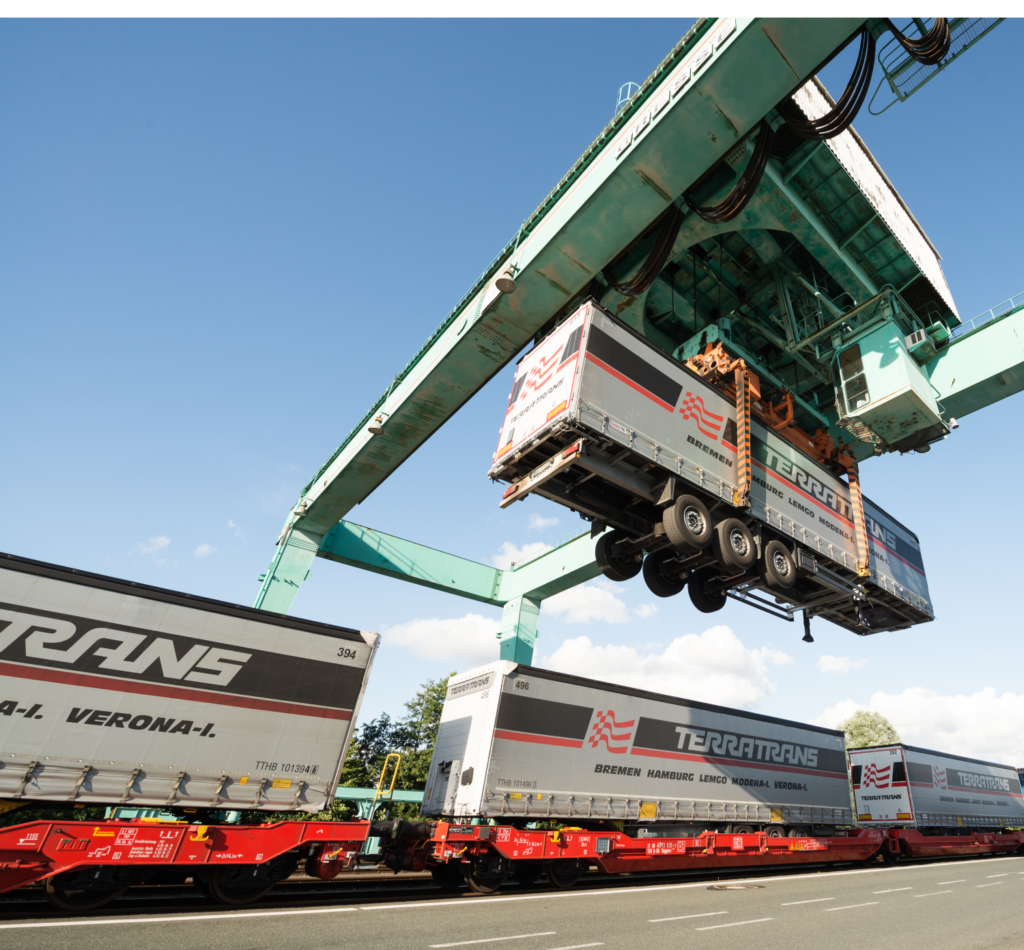
Those who opt for rail can bypass the lorry driving bans in Tyrol. They save the valuable resource of drivers’ working time and, above all, reduce the burden on the environment and climate: CO₂ savings compared with road transport alone amount to around 80 per cent. The longer the route, the more these benefits come into play: for the freight forwarder Terratrans from Bremen, the Brenner Pass is the main artery. “Northern Germany to Northern Italy is our busiest route, and the bulk of it runs by rail,” explains Managing Director Arne Müller. From an operational perspective, combined transport beats road transport over this distance: one night on the train instead of two driver shifts, no driving time issues, no block clearance, no weekend driving bans. “And without rail, we simply wouldn’t be able to move these volumes with our drivers. For us, combined transport is also a solution to the driver shortage, not just to our carbon footprint.” The company has been active in intermodal transport for four decades and transports a wide range of goods under tarpaulin – whether beverages, tiles, ceramics, DIY supplies, chemicals, metal or steel. The Kombiverkehr customer moves around 15,000 loading units annually and also operates its own company train from Bremen to Verona.
Despite all the strong arguments in favour of rail, combined transport is by no means a sure-fire success. A large number of construction sites are affecting service quality, leading to train cancellations and detours, and consequently to delays. Those bearing the brunt are the freight forwarders, who criticise the lack of predictability in their rail transport and are calling for higher standards – not least in the interests of their customers.

Internationale Spedition GmbH
For freight forwarder Müller, the main problem is the bottleneck situation: “The Brenner isn’t overloaded because there are too many trains running. It’s overloaded because there aren’t enough tracks,” he explains, citing the following points: an existing double-track line, a gradient of 29 per mille, three locomotives per train, and the fact that the line has been operating close to capacity for years. Construction works are hampering operations not only on the German side: from 18 July to 2 August, the Brenner line was closed due to corridor renovation works and only every second train was able to take the significantly longer diversion via Tarvisio, adding 250 extra kilometres to the journey.
Corridor refurbishments pose challenges for freight rail operators and freight forwarders
Ruby van der Sluis, managing director of the rail transport company (EVU) Lokomotion, confirms that transalpine rail freight transport presents challenges. Last-minute construction work made it difficult to provide planning certainty for customers and shippers waiting for their cargo at the destination station. Lokomotion transports almost 10,000 trains a year via the Brenner Pass and, according to its own figures, is the leading rail operator on the Munich–Brenner–Northern Italy route. The corridor renovation works currently underway in Germany are causing particular difficulties for rail operators and service providers. Take the Nuremberg–Regensburg–Passau route, for example: the first section has been completed, whilst the second is expected to last until the end of the year. The impact is significant. As trains are being diverted via Munich, the Munich–Rosenheim line is significantly overloaded. This is just one example of many during the corridor renovation works.
Stakeholders in the rail freight sector are viewing the next major construction project with great concern, as it too will have an impact on transalpine traffic. The Munich–Rosenheim section is due for refurbishment in 2028. Lokomotion lodged a complaint with the Federal Network Agency against the planned five-month closure of this corridor. DB InfraGO subsequently agreed to revise the plan. “We are pleased that the plan has been revised over the past few months,” explains Lokomotion’s CEO, van der Sluis. “It is clear, however, that any kind of full closure on this TEN corridor will have massive economic repercussions on transport operations and on us as a company,” she says, arguing that on corridors without adequate diversions, the passability of the routes must be guaranteed.
If rail service quality is compromised by construction works, freight forwarders may be inclined to shift more freight back onto the roads. Both Lokomotion and Kombiverkehr report that freight forwarders are even more price-sensitive in the current situation. Kombiverkehr’s Managing Director, Dirk Steffes, is calling on politicians to do more to drive forward the modal shift and, in the short term, to retain freight forwarders in intermodal transport. “We appeal to them, amongst other things, to compensate for the additional costs incurred by freight forwarders as a result of the construction work,” he says. “A toll exemption for combined transport would be an important first step towards compensation with a rapid impact,” he believes.
Returning to the Munich–Rosenheim corridor: according to DB InfraGO’s revised plans, the Bavarian section is to be upgraded in two phases. The second phase is scheduled for 2031. If everything goes to plan, everything would be ready in time for the opening of the Brenner Base Tunnel. That would send an important signal to many, including those in Tyrol. After all, the same slogan applies to rail users as it does to residents in Tyrol: freight on the railways instead of an avalanche of traffic!
Comments are closed.